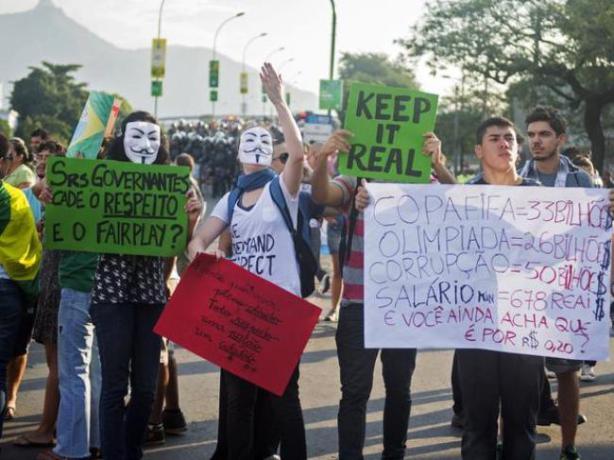
Protesters against mega events in Brazil. © unknown.
One of the many important issues concerning mega events is the negative impacts such large-scale events might have on host communities. The impacts are not only present during or after the events, but will happen even before the they take place. I wrote this brief, modest post in response to a question I’m often asked (as a tourism and events lecturer), to give those interested in the topic a little food for thought and hopefully continue to raise awareness of this important subject.
Economic or Social Benefits?
When talking about the impacts of mega events, the first thing we usually think about is the positive economic benefits that they might bring (as questionable as this concept may be. After careful consideration, however, one might conclude that it is not always possible to separate the economic impacts from the social ones , nor are standard guidelines on what can be considered social or economic impacts totally agreed upon. For instance, the Olympic Games Impacts Study produced by Price Waterhouse Coopers in 2005 commissioned by the UK’s Department for Culture Media and Sports investigated potential social impacts of the Olympic games in three areas, i.e. people (skills and employment), sporting and cultural legacy and public health. These are questionable areas to say the least, i.e. whether employment is an economic impact, a social one or both, what the value of sporting and cultural legacies are, and so on. Just look at the sporting legacy created by the Olympic Games in Greece. In London, the Olympic Park is taking more than a year after the games for the facilities to be fully open to the public. What the London games will have achieved socially is yet to be confirmed. Moreover, does the host city really need to build such colossal facilities for an event that lasts a couple of weeks when it may already have a range of facilities that are usually underused? The biggest question remains: How can we measure the social benefits of hosting such events?
Academics and researchers have discussed the topic from various angles, ranging from tourism destination and image to political impacts. These Higher Education Academy compendiums Resource Guide to the Olympic Games and The Impact of Events confirm that. The two important points I am trying to make here are: that the discussion on the social impacts of mega events should not be exclusive to academia and that more studies should be dedicated to the social impacts of events in the pre-event stages. There are many angles we can take the discussion further, for instance: Should we agree with Mark Perryman that “the Games are designed to serve the interests of the IOC in maintaining and defending their very particular model of the Olympics, and not the needs of the host city and nation”? Or indeed with Andrew Zimbalist’s idea that “the environment in which the preparations for the Games takes place is not conducive to rational, effective planning”? From an economic point of view, Tien et al suggest that “the economic impact of hosting the Olympic Games on host countries is only significant on a short-term basis in some parameters, i.e. GDP performance and unemployment in the pre-Games phase”. This is precisely the point I’m concerned with. Are economic indicators enough to justify hosting such costly events? I don’t think so. The main purpose of hosting the Olympic Games and other similar events is (or should be) to promote social development and well-being that create legacies both in the short and long run, but do they really?
What about pre-event social benefits?
Official sources try to do what’s called boosterism and portray the positive benefits that these mega events will bring, as seen in the official Olympic City website. Reality, however, can be quite different as the project undertaken by Paêbirú Realizações Cultivadas tries to show. It depicts a city under siege by “legal forces” as can be seen in the video below. Professor Carlos Vainer from the Federal University of Rio de Janeiro, a mega events researchers, explains that “from a neoliberal perspective, the (hosting) city is de-politisised because it’s transformed into a business”; or worse still, in the words of congressmen Marcelo Freixo, the upcoming mega events are being used as an excuse for “social cleansing”.
More on the social reality of Brazil in this blog post and the video below.
Another aspect of social impacts of mega events is that of social justice. Can cultural and social benefits be achieved pre-event if construction workers are treated the way they are being treated in Qatar? (as discussed in this BBC article). Should large international events be hosted in countries where freedom of speech or sexual orientation, both basic precepts for social and cultural development, do not exist? This article about the situation in Russia makes one think they shouldn’t.
To host or not to host?
When asked whether I’m in favour of hosting mega events, I say: ‘ In my opinion, there is little value in hosting such expensive mega events in their current form. They are usually a political excuse with hidden purposes, and although they might be useful to improve the country’s image overseas and even that is debatable without further academically rigorous research to support the notion’. Money would be better spent on education and health, particularly in developing countries where these important social benefits are not adequately provided. I have not yet found enough evidence otherwise.
 Eventade
I like the helpful information you provide on your articles.
I will bookmark your weblog and take a look at again right here frequently.
I am reasonably sure I will be informed a lot of new
stuff proper here! Best of luck for the following!